Mean Value Theorem and Taylor's Theorem
But now look again at the mean value theorem alias Taylors theorem with N 0. Cauchys Mean Value Theorem Statement.

Calculus Continuity Of F N 1 In Taylor S Theorem With Mean Value Remainder Mathematics Stack Exchange
However the mean value theorem for a vector-valued differentiable function does not exist.

. We establish analogues of the mean value theorem and Taylors theorem for fractional differential operators defined using a Mittag-Leffler kernel. The derivation is described as follow. Mathematics Department Stanford University Math 51H Mean value theorem Taylors theorem and integrals If fis a C1 real valued function on an open set UˆRn we have for any x h i with khksu ciently small that fx he i fx hf0x he i for some 201.
For any in ab by Lagranges mean value theorem there exists 2. This result is a particular case of Taylors Theorem whose proof is given below. This is the form of the remainder term mentioned after the actual statement of Taylors theorem with remainder in the mean value form.
This theorem is used to prove statements about a function on an interval starting from local hypotheses about. F x he i f x hf x θ he i for some θ 0 1. Remember that the Mean Value Theorem only gives the existence of such a point c and not a method for how to find c.
Suppose f 0x 0 for any x 2ab. If two functions fx and gx are 1. It is one of the most important results in real analysis.
Namely if f is differentiable at least n 1 times on ab then x ab fx P n k0 fka. R_2y frac12fzy-x2 which gives the result you may be looking for. We understand this equation as saying that the difference between fb and fa is given by an expression resembling the next term in the Taylor polynomial.
Math 51H Mean v alue theorem T a ylors theorem and in tegrals. Suppose f has n 1 continuous derivatives on an open interval containing a. 1 Mean Value Theorem Let hx be differentiable on ab with continuous derivative.
Then for each x in the interval f x k 0 n f k a k. If f is a C 1 real v alued function on an op en set U R n w e ha v e for an y x h i with k h k sufficien tly. The important thing about this inequality is that it says that the di erence between fxandfa is at worst linear in the distance between x and a.
Differentiable on ab and gx 0 then there exists at least one value of x such that c ab d a e a d d _ e e _ Generally Lagranges mean value theorem is the particular case of Cauchys mean value. X ak plus an error that is at most max acx f n1cxa 1. The Lagrange form of the remainder is found by choosing G t x t k 1 displaystyle Gtx-tk1 and the Cauchy form by choosing G t t a displaystyle Gtt-a.
In mathematics the mean value theorem states roughly that for a given planar arc between two endpoints there is at least one point at which the tangent to the arc is parallel to the secant through its endpoints. If we take b x and a x0 in the previous result we obtain that. The mean value theorem and Taylors expansion are powerful tools in statistics that are used to derive estimators from nonlin-ear estimating equations and to study the asymptotic properties of the resulting estimators.
Mean Value Theorem and Taylors Theorem Mean value theorem LHopitals rule Taylors theorem Theorem If f x is a di erentiable function such that f 0x 0 for any x 2ab then f x is strictly increasing. Taylors Theorem Di erentiation of Vector-Valued Functions Mean Value Theorem for Vector Value Functions Theorem 519 Suppose f is a continuous mapping of ab into Rn and f is di erentiable in ab such that jfb faj b ajf0xj. Formulae 6 and 10 obtained for Taylors theorem in the ABC context appear different from classical and previous results mainly due to the replacement of power functions with a more general form of summand.
In the proof of the Taylors theorem below we. The mean value theorem MVT also known as Lagranges mean value theorem LMVT provides a formal framework for a fairly intuitive statement relating change in a function to the behavior of its derivative. So by Mean Value Theorem exists z in x y st.
This can be considered to be a second-order Mean Value Theorem. Suggests that we may modify the proof of the mean value theorem to give a proof of Taylors theorem. Rst by subtracting a linear ie.
X a k R n 1 x where the error term R n 1 x satisfies R n 1 x f n 1 c n 1. Continuous on ab 2. The theorem states that the derivative of a continuous and differentiable function must attain the functions average rate of change in a given interval.
Next the special case where fa fb 0 follows from Rolles theorem. Using just the Mean Value Theorem we prove the nth Taylor Series Approximation. It says that if f is di erentiable then fxfaf0cxa and so if jxaj then jfx faj max c2ax jf0cj.
We formulate a new model for the fractional Boussinesq equation by using this new Taylor series expansion. By the mean value theorem we have assuming that f has the differentiability properties requires for an infinite Taylor expansion fxDeltafxDeltacdotfracdfdxxi_1quad x. Degree 1 polynomial we reduce to the case where fa fb 0.
Extended Mean Value Theorem If f and f0 are continuous on ab and f0 is difierentiable on ab then there exists c 2 ab such that fb faf0aba f00c 2 ba2. This lemma implies the k2 case of Taylors Theorem since we have beginalign R_a2h fah - left fa h fa frac h22faright frac h22 left fatheta h - faright. In this manuscript we have proved the mean value theorem and Taylors theorem for derivatives defined in terms of a MittagLeffler kernel.
T o see this let. The proof of the mean-value theorem comes in two parts. Fz fracfy - fxy-x fracR_2yy-x textor R_2y fzy-x Taking anti-derivative with respect to y where fz is just a constant here we have.
The Mean Value Theorem of Derivatives is related to the Taylor Series in that the Mean Value Theorem concludes that any Taylor Series approximation may be made perfect by adding the next term left out of. Here fa is a 0-th degree Taylor polynomial. The Taylor Series can also be used to approximate the value of a function at a nearby base value.
Calculus Mean Value Theorem And The Taylor Series Youtube
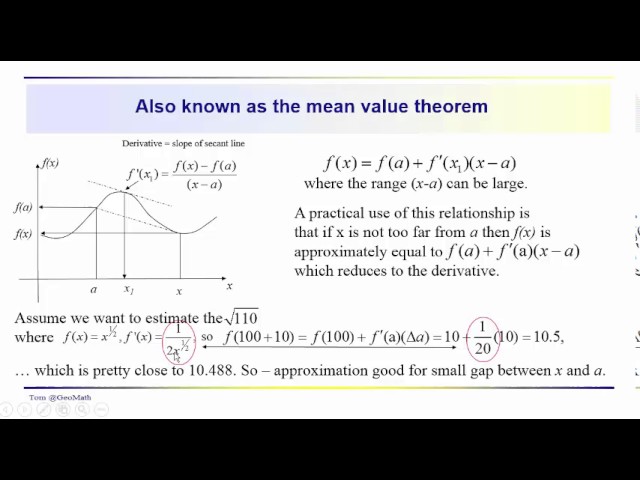
Calculus Mean Value Theorem And The Taylor Series Youtube

How Is Taylor S Theorem Like The Mean Value Theorem Week 6 Lecture 7 Sequences And Series Youtube
No comments for "Mean Value Theorem and Taylor's Theorem"
Post a Comment